
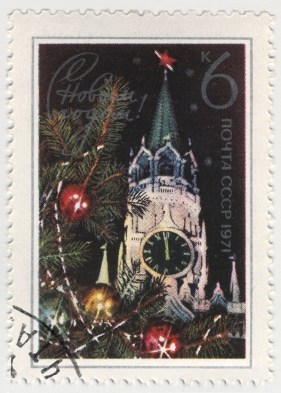
USSR – CIRCA 1970: stamp printed in USSR shows New Year symbols, devoted to the New Year 1971
Have you ever wondered what will happen in Russia in the upcoming year? How can we get clues? A fascinating resource that unites historical and linguistic information in a condensed form is available each year to provide some answers and foresight. This fount of information is the collection of New Year’s Eve addresses that have been presented by Soviet and Russian leaders over the past almost fifty years. This blog is about how we can deduce linguistic, social, and even economic information from the New Year’s Eve addresses and determine what these speeches can tell us about historical events.
The tradition of the New Year’s Eve address started on December 31, 1970 with the speech given by Brezhnev. The addresses soon became an established part of the traditions associated with New Year celebrations in the Soviet Union, and later in Russia, together with the New Year tree, gifts, and traditional food. I have gathered all the addresses that have been given since 1970 and provide them on this website (in Russian). They are divided into 20th century addresses and 21st century addresses.
This first post describes how and why I collected these addresses. I first became interested in these unique speeches when I attended a conference talk by Fidler and Cvrcek who had analyzed the New Year addresses given by the leaders of Czechoslovakia. I began to realize that New Year addresses could provide a wealth of information. They are transmitted every year, they are influenced by historical events, and they have a codified form, so historical information can easily be found in these texts. Moreover, they reflect the socio-economic and cultural climate of the time, not only through the historical information they hold, but also through linguistic clues.
My first task was to collect all the addresses. Luckily, during Soviet times the New Year’s Eve addresses were printed on New Year’s Day on the front page of Pravda (‘Truth’), the most important daily newspaper in the Soviet Union. An electronic version of all the Pravda issues is available. However, I quickly found that although I could search through the newspapers easily enough, the quality of the photocopies was poor and I was not always able to read the text. So, this part of my journey led me to the basement of the local university’s library where the microfilms of old newspapers were stored.
There is a certain irony in that, at some point, most people envisioned that microfilming would be the technology of the future, and now it is associated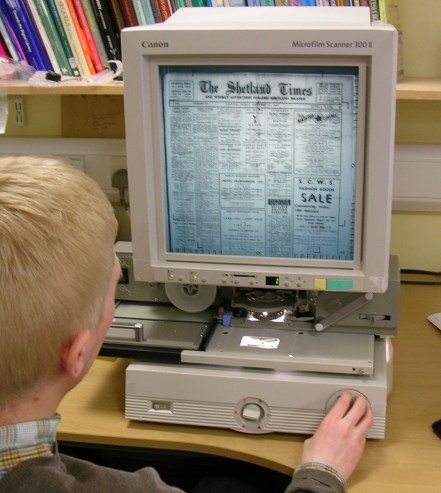 only with the past. For me, this was my first experience working with microfilm. In order to access the collection, I had to use a special designated elevator to the basement of the building, which only the people who wanted to access microfilm were allowed to use. The staff members there were delighted to see someone at all and seemed to enjoy helping me learn how to view microfilm on the screen of the reader (similar to the one shown to the right) and how to convert the images on the screen to pdf files. I typed in all the New Year’s Eve addresses from 1970 to 1991 using those copies.
Unfortunately, the practice of publishing the New Year addresses, which was so helpful for the generations of historians to come, suddenly stopped in 1992. Until 1992, the front page of the newspaper clearly indicated that Pravda was the main media outlet of the Communist Party, but on January 1, 1992, the New Year address is missing and in its place on the front page is a horoscope – a clear sign of change.
In addition to the New Year addresses, a considerable amount of cultural and historical information is provided by the overall appearance of the New Year’s Day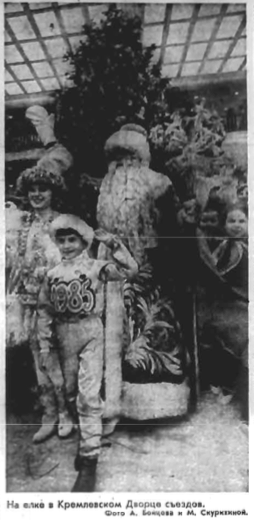 front page. For example, pictures in the January 1 editions tell their own story. In the newspapers from 1971 to 1984, the New Year’s Eve addresses sometimes were accompanied by a picture of the leader, however most often they were printed next to an impersonal picture, such as a photograph of the Spasskaya tower with the Kremlin clock or a drawing of a hammer and sickle in front of the clock. Year 1985 was the first year since 1971 when ordinary people appeared in the front page photo of Pravda on January 1. The photo from the front page of that year shows traditional participants of the New Year celebration in front of the Kremlin Palace of Congresses. It portrays Ded Moroz (a fictional character similar to Father Christmas), Snegurochka (the Snow Maiden), and a boy who represents the New Year. Later that year (1985), Gorbachev came into power and started a process that eventually led to “socialism with a human face”, but apparently something was already in the air on the eve of 1985, inadvertently evidenced by Pravda’s front page photo. This change opened doors to other changes, which eventually led to the New Year address no longer appearing in Pravda seven years later.
Most of the more recent New Year addresses are available online. However, I couldn’t find the New Year address given by Yeltsin on December 31, 1997. My brother-in-law, a journalist, suggested that I contact the Yeltsin Center’s archives that store all the documents that are pertinent to Yeltsin’s rule. I wrote to the Center and explained that I was conducting a study of the New Year addresses and had collected all but the one from 1997, and asked if they could provide the missing address. They were very kind and promptly sent me a pdf file of what appears to be the original document that Yeltsin would have actually used to read the address. In this document, to my surprise, some of the words are in bold print. It seems that these are the words that were supposed to be the intonational focus when spoken aloud. I am now wondering whether this use of bold font to stress particular words was standard practice for written speeches or if this was an accommodation made specifically for Yeltsin.
The curators of the Yeltsin Center foundation have written to me occasionally since that initial contact and have asked if I’ve published any further research about the New Year addresses. This blog is my first step towards that effort. My next post will explain how I deduced information from the most frequent words found in the New Year addresses.


Very informative. I look forwarding to following this blog.
LikeLike